Beit: first letter of Torah,
Beit: second letter of Alef-Beit.
Beit = BYT = 2+10+400 = 412 = 7,
Beit = 'house'.
A house defines inside,
And defines outside.
Work: outer processing,
Rest: inner processing.
Six days of outer processing,
One day of inner processing.
The completion of the outer Beit is Shabbat,
Shabbat is the beginning of the inner Beit.
The house is prepared to dwell inside,
The bride is welcomed into her home.
Showing posts with label torah. Show all posts
Showing posts with label torah. Show all posts
Friday, December 5, 2014

Friday, November 7, 2014
The 613 Mizvot of the Torah and the Metatronic Overself
There
are 613 Mitzvot in the Torah, divided into 248 obligations and 365
prohibitions. We often hear about the importance of doing Mitzvot, and
some even say that the coming of the Messiah is directly related to
performance of the Mitzvot. But that is just the surface-level view
(p'shat). But what is the secret (sod) of the Mitzvot?
From a higher perspective, the Torah is the collective dreambook of all Metatronic Overself programs of Adamic evolution. At this level, we see that the Overself is constructed out of the all the Mitzvot - it is always doing all 248 obligations and never does any of the 365 prohibitions. Esoterically, this is the Gan Eden - the state of being in which the performance of all 613 Mitzvot is a simultaneous reality. But does this mean that we should not practice Torah and perform Mitzvot daily?
When the Overself emanates an individual spirit, it must enter the dimension of time. This means that the state of resonance with the Mitzvot is variable and can change dynamically. Therefore, actual physical performance is needed to achieve vibrational resonance with the Mitzvot. This opens up Overself functionality to the individual spirit.
The study of the laws of the Mitzvot and the sections of the Torah in which the Mitzvot are defined is a major educational imperative in Talmud Torah. Understanding the principles and goals of Mitzvot observance are a key to unlocking the mysteries of our Overself.
From a higher perspective, the Torah is the collective dreambook of all Metatronic Overself programs of Adamic evolution. At this level, we see that the Overself is constructed out of the all the Mitzvot - it is always doing all 248 obligations and never does any of the 365 prohibitions. Esoterically, this is the Gan Eden - the state of being in which the performance of all 613 Mitzvot is a simultaneous reality. But does this mean that we should not practice Torah and perform Mitzvot daily?
When the Overself emanates an individual spirit, it must enter the dimension of time. This means that the state of resonance with the Mitzvot is variable and can change dynamically. Therefore, actual physical performance is needed to achieve vibrational resonance with the Mitzvot. This opens up Overself functionality to the individual spirit.
The study of the laws of the Mitzvot and the sections of the Torah in which the Mitzvot are defined is a major educational imperative in Talmud Torah. Understanding the principles and goals of Mitzvot observance are a key to unlocking the mysteries of our Overself.
Wednesday, April 30, 2014
The Fractality of Torah Literature
All Torah literature is inherently interconnected with itself. This
is mathematically modeled by fractal geometry. Mathematically, a
fractal is a self-similar geometric object that reiterates the global
structure at every localized scaling perspective.
Reading any of the teachings of the sages is like reading them all. Understanding any little bits of Torah wisdom is like understanding them all. But you can't fully appreciate the ramifications of each little bit of Torah wisdom unless you have first become familiar with the full spectrum of Torah literature.
The Torah, TaNaK, Mishnah, Talmud, Midrash, Zohar, etc... are all interconnected in this way. Fractal geometry is the easiest way to understand how to read and study Torah literature.
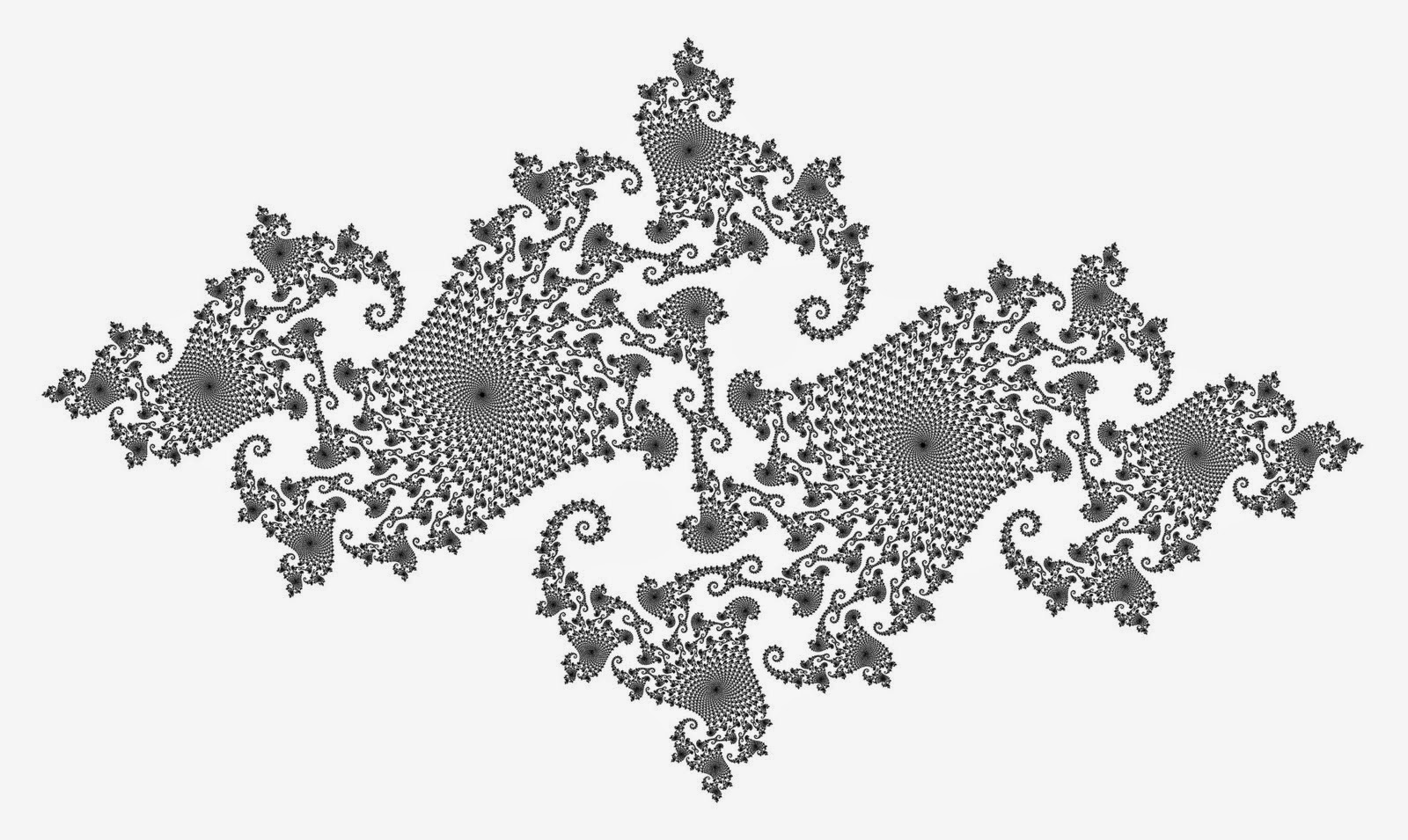 |
| A Julia set fractal - a vision of Torah literature |
Reading any of the teachings of the sages is like reading them all. Understanding any little bits of Torah wisdom is like understanding them all. But you can't fully appreciate the ramifications of each little bit of Torah wisdom unless you have first become familiar with the full spectrum of Torah literature.
The Torah, TaNaK, Mishnah, Talmud, Midrash, Zohar, etc... are all interconnected in this way. Fractal geometry is the easiest way to understand how to read and study Torah literature.
Friday, March 14, 2014
The Seven Paths of Torah by Abraham Abulafia - A Model for Divine Revelation
Torah is a book like no other - endless in its mysteries, infinite in depth, able to be opened at any place and behold! - endless secrets are waiting there to be discovered. But these secrets are not apparent on the surface. We must ply through its outer layers before the light can shine through. Torah hides herself within the clothing of stories and narratives, laws and commandments, but this is only so that those who seek her essence, to behold her light unadorned, must demonstrate their desire for her by careful study. The type of study that is able to open up the hidden layers of the words of Torah is known as Kabbalah.
Kabbalah means "that which is received", that is, a system of tools and a method of study that requires full engagement of the mental faculties, and also, but perhaps most importantly, a kindling of desire to know her, to be touched by her, a heartfelt passion gaze upon her naked radiant beauty, a painful longing to "receive" her deepest secrets. To the learned Kabbalist, Torah is no less than a love letter from God, but we must learn to read and comprehend in a way that is highly elevated if we are to perceive the deeper mysteries.
If we metaphorically see the Torah as a love letter from God, then opening the envelope that contains this love letter is not so simple. To the Kabbalist, once the envelope is opened, there is another envelope inside, but we must learn new techniques to open the next envelope. It keeps going like this ─ envelope within envelope, layer within layer, depth within depth ─ and we must learn a new set of techniques, a new set of skills to open the next layer.
But this is not done with the mind alone, for it is only the strength of desire, the heating of the flame of passion, to want to know God, to love God and feel the love of God, to be with God and sing His song with Him in timeless eternity ─ it is only these 'modest' requirements that can open up the next layer, for the divine love is so powerful it would annihilate those not strong enough to be completely permeated by it.
It is God's great mercy that these requirements are in place, for God would not want to destroy us with his infinite love if we are not looking for it. But all will come in their appropriate time, with their befitting preparation, and their honest decision to be united in bliss, as every organ of the body, every layer of tissue, down to the center of every cell and atom, vibrate together with the heartbeat of God's boundless love of all that is.
The Kabbalistic model for the aspect of God that is the object of desire is called Shekhinah - the Divine Presence, understood to be a feminine energy. The Torah is always described in female terms ─ indeed the grammatical marker for a feminine noun is the consonant Heh at the end of a word, making the word "Torah" grammatically a feminine noun.
The Shekhinah is understood to be the inner spirit of Torah. The Kabbalist longs to behold Shekhinah by penetrating through the layers of Torah, a journey of descent through text that parallels the adventure of ascent in thought ─ this is the quest of encountering the Shekhinah naked and undressed, who is ready and waiting to meet those lovers who have proved themselves worthy to find her, to couple with them, to be inseminated by their desire to know the divine mystery, gestating their wish for knowledge of hidden things, and giving birth to new ideas which she departs into the minds of those who find her.
But if the Torah is what we know as "The Bible", then why doesn't everyone "go all the way", as it were, to reach the knowledge of Shekhinah, in the sense of "and Adam knew his wife Eve" (Genesis 4:1)? The answer is that most do not have the awareness that there is a hidden dimension of Torah, a system of layers within layers, envelopes within envelopes, that must be opened up in sequence and with the proper techniques ─ the toolkit of Kabbalistic study, and the burning flame of desire to know God.
In a small book titled The Seven Paths of Torah, Rabbi Abraham Abulafia presents a model of seven layers of depth of Torah, each within the other, each requiring greater skill and more intense desire. He calls each of these layers "paths", the Hebrew word here is "netivot". This term is also used to indicate the "32 Wondrous Paths of Wisdom" (c.f. Sefer Yetzirah 1:1) as well as the 22 paths of the Tree of Life diagram, corresponding to the 22 letters of the Hebrew alphabet.
It is worth contemplating Abulafia's model, and using it as a roadmap for Torah study. Let's examine what Abulafia has to say about the each of the paths (translation follows that of Sheva Netivot haTorah, 2006 Providence University Press):
That is, the first path is the topmost layer of depth, the surface meaning which can be grasped and comprehended by anyone with the ordinary faculties of comprehension. Here, we learn the details of the stories and narratives, and the specifications of laws and commandments.
But the important thing is not to discount the importance of this first path! For it contains the doors and openings that will be pryed open as we venture further in to the mystery. All of the details of people's names, places they travel, their ages at key points in life, the precise details of the commandments, the length of times decreed for festivals ─ all of this can be opened up to reveal secret knowledge, all can be used to discover hidden gems of knowledge and wisdom. Even right down to the smallest details of how many words comprise a verse or phrase, or the individual letters and their numerical values, there are no insignificant details in Torah, for the whole Torah is an interface ─ if we can penetrate beneath the surface we may gaze upon the face of God.
The Mishah is known as the Oral Torah, and together with its elaboration in the Gemara comprise the Talmud, of which there are two ─ Talmud Bavli and Talmud Yerushalmi. These texts elaborate primarily on the system of legal ordinances given in the text of Torah, although there are many sections that deal with the meaning of the stories and narratives, as the Torah is a whole unity, a perfection which cannot be reduced to parts. Thus, to fully comprehend the meaning of the laws, it is necessary to understand the context of the narratives though which those laws were given.
The Mishnah and the Talmud are used as the basis of Halakhah, the system of rules of daily living which specify the right way to live one's life to be in fullest harmony with Torah. The Halakhah is seen by many as a highly restrictive and outdated legal system, but the real purpose is that the legal portions of the Talmud are really describing higher-dimensional laws and systems of organization that are the patterns of thought and transformation of mental and spiritual energy, such that by living one's life according to Halakhah, one is really living in harmony with divine patterns and structures that shape our reality.
Delving deeper into the text, we come to the method of Darash, from which the more common term Midrash comes. The Midrashic literature is characterized by exploring the details of the text of Torah and looking for patterns that may be more or less apparent. The sages of the Midrash present the peculiarities of these textual patterns, explore their significance, and look for clues to deeper meanings from other, perhaps even far distant, sections of Torah, as well as looking to the Prophets and the Writings for further insight.
Abulafia goes on to say that the majority of people who read the Torah will only get as far as the first three paths, and specifically that many may be able to comprehend the Oral Torah and perform the mitzvot (commandments) accoding to the specifics of Halakhah, but that the path of Midrash is somewhat more restrictive, requiring disciplined study and an inquiring mind. While the fourth path is still available to all who would like to go this far, only a few will have the patience and will to puzzle themselves over parables and allegories in order to discover a deeper layer of knowledge.
This is an unequivocal statement that the real meaning of Kabbalah is a level of study deeper than Mishnah and Talmud, and deeper than Midrash! Abulafia even states that "it is here that we separate from the masses of the world, from the wise of the nations and from the same wise Rabbis of Israel". Although the level of their wisdom is great and profound, they still do not penetrate to this fifth level. This is highly intriguing, for if this is so, then what mysteries lie waiting beyond, into the sixth and seventh levels?!
Abulafia gives examples of what type of teachings are available along this fifth of the seven paths. He observes that the first letter of Torah, the letter Bet of Beresheet, is written on the Torah scroll in a larger size than the rest of the letters. Why is this letter written larger than the other letters? Giving other similar examples, and citing other seemingly insignificant details of the Torah, such as "full writings and defective writings, bound letters and crooked letters", he says that the meaning of these peculiarities is a mystery only known to the Kabbalists.
These are the standard methods of Kabbalistic exploration. What could be construed by those lacking understanding as number and letter games, are actually part of a scientific method for opening up layers and depths of Torah. As stated above, the first path, the comprehension of the surface meaning, would provide all the openings that would be used to penetrate to deeper layers. Here we see that the names of people and places, the numbers of their lifespan, their ages when significant events happen, are all used as the raw material for applying the tools of Gematria (equivalence of numerical values), Notariqon (forming acronyms from consecutive strings of words and verses), and Terumot (subsitution cyphers and cryptograms).
But these methods cannot be applied by just anyone. A competent Kabbalist is one who has penetrated to this sixth layer by mastering all of the previous layers as well, a full knowledge of Talmud and Midrash, and a keen eye for extracting deep secrets from seemingly minor, insignificant details of the text of Torah. One is highly susceptible to err in this territory without first mastering the previous paths.
What now, after all this, could be said about the seventh and final path according to Abulafia's model of the "Seven Paths of Torah"?!
The "influx that propogates from the name" could be understood as Shekhinah, the Divine Presence, the spirit of prophecy that puts the "divine speech" in the prophet's mouth. Abulafia is not being unnecessarily dodgy about describing the nature of the seventh path ─ it is a mystery that is literally indescribable. Although he does say a great deal when he says that it can be "learned from a living voice". Here he is saying that it involves the divine energy that can only be accessed through the intonation of the divine names, specifically referring to the 42-letter and 72-letter divine names.
It is not the place to describe these systems of divine names here ─ that information can be found from many sources, especially in Abulafia's other texts. But we must realize that it is one thing to read about the names and understand their construction, and it is a whole different reality to be in the presence of a Kabbalist while they are performing the intonation of the names. The intonation of these divine names creates a frequency, a carrier wave, on which the Shekhinah can ride, and manifest the Divine Presence into the space in which the Kabbalist performs his miracles.
Abulafia's other works, such as Chayye haOlam haBa and Or haSekel are the practical manuals that give the specific details on how to perform the intonation of the Divine Names, the goal being that the Shekhinah, the spirit of prophecy, may rest upon the Kabbalist and put "divine speech in his mouth".
With these elusive statements, Abulafia is also alluding to many other Kabbalistic teachings regarding the power of divine names. It has been said that the entire Torah is a divine name, and that many divine names can be discovered hidden within each and every verse and word of Torah. I think it is reasonable to conclude that the nature of the seventh path is the mysteries of the divine names, their derivation from verses and words of Torah, their combination, their intonation, and the gift of prophecy they bring to the desiring Kabbalist.
Of course we must reiterate that advancement along the seven paths is not just a work of the mind, but also very importantly a work of the heart. There must be long and difficult studies, patient and careful learning, and the skillful application of highly advanced methods and techniques ─ this is the work of the mind. But it is only though the desire of the heart and the love of God that one will persist along these paths to become adept enough to properly intone the divine names. It is not about just knowing how to say the words and intone the formulas, but it is the bonding with Shekhinah in the depth of one's heart that allows one to sing the holy Names together with Shekhinah in holy and loving union.
Books mentioned in this article are available from Amazon.com:
 |
| Sefer Torah |
Kabbalah means "that which is received", that is, a system of tools and a method of study that requires full engagement of the mental faculties, and also, but perhaps most importantly, a kindling of desire to know her, to be touched by her, a heartfelt passion gaze upon her naked radiant beauty, a painful longing to "receive" her deepest secrets. To the learned Kabbalist, Torah is no less than a love letter from God, but we must learn to read and comprehend in a way that is highly elevated if we are to perceive the deeper mysteries.
If we metaphorically see the Torah as a love letter from God, then opening the envelope that contains this love letter is not so simple. To the Kabbalist, once the envelope is opened, there is another envelope inside, but we must learn new techniques to open the next envelope. It keeps going like this ─ envelope within envelope, layer within layer, depth within depth ─ and we must learn a new set of techniques, a new set of skills to open the next layer.
But this is not done with the mind alone, for it is only the strength of desire, the heating of the flame of passion, to want to know God, to love God and feel the love of God, to be with God and sing His song with Him in timeless eternity ─ it is only these 'modest' requirements that can open up the next layer, for the divine love is so powerful it would annihilate those not strong enough to be completely permeated by it.
It is God's great mercy that these requirements are in place, for God would not want to destroy us with his infinite love if we are not looking for it. But all will come in their appropriate time, with their befitting preparation, and their honest decision to be united in bliss, as every organ of the body, every layer of tissue, down to the center of every cell and atom, vibrate together with the heartbeat of God's boundless love of all that is.
The Kabbalistic model for the aspect of God that is the object of desire is called Shekhinah - the Divine Presence, understood to be a feminine energy. The Torah is always described in female terms ─ indeed the grammatical marker for a feminine noun is the consonant Heh at the end of a word, making the word "Torah" grammatically a feminine noun.
The Shekhinah is understood to be the inner spirit of Torah. The Kabbalist longs to behold Shekhinah by penetrating through the layers of Torah, a journey of descent through text that parallels the adventure of ascent in thought ─ this is the quest of encountering the Shekhinah naked and undressed, who is ready and waiting to meet those lovers who have proved themselves worthy to find her, to couple with them, to be inseminated by their desire to know the divine mystery, gestating their wish for knowledge of hidden things, and giving birth to new ideas which she departs into the minds of those who find her.
But if the Torah is what we know as "The Bible", then why doesn't everyone "go all the way", as it were, to reach the knowledge of Shekhinah, in the sense of "and Adam knew his wife Eve" (Genesis 4:1)? The answer is that most do not have the awareness that there is a hidden dimension of Torah, a system of layers within layers, envelopes within envelopes, that must be opened up in sequence and with the proper techniques ─ the toolkit of Kabbalistic study, and the burning flame of desire to know God.
* * *
In a small book titled The Seven Paths of Torah, Rabbi Abraham Abulafia presents a model of seven layers of depth of Torah, each within the other, each requiring greater skill and more intense desire. He calls each of these layers "paths", the Hebrew word here is "netivot". This term is also used to indicate the "32 Wondrous Paths of Wisdom" (c.f. Sefer Yetzirah 1:1) as well as the 22 paths of the Tree of Life diagram, corresponding to the 22 letters of the Hebrew alphabet.
 | |
| Rabbi Abraham Abulafia (1240 - 1291 C.E.) |
It is worth contemplating Abulafia's model, and using it as a roadmap for Torah study. Let's examine what Abulafia has to say about the each of the paths (translation follows that of Sheva Netivot haTorah, 2006 Providence University Press):
"The first path contains the literal understanding of the Torah... This is the road that is suitable to the mass of people, men, women, and little children."
That is, the first path is the topmost layer of depth, the surface meaning which can be grasped and comprehended by anyone with the ordinary faculties of comprehension. Here, we learn the details of the stories and narratives, and the specifications of laws and commandments.
But the important thing is not to discount the importance of this first path! For it contains the doors and openings that will be pryed open as we venture further in to the mystery. All of the details of people's names, places they travel, their ages at key points in life, the precise details of the commandments, the length of times decreed for festivals ─ all of this can be opened up to reveal secret knowledge, all can be used to discover hidden gems of knowledge and wisdom. Even right down to the smallest details of how many words comprise a verse or phrase, or the individual letters and their numerical values, there are no insignificant details in Torah, for the whole Torah is an interface ─ if we can penetrate beneath the surface we may gaze upon the face of God.
"The second path contains the understanding of the text according to manifold commentaries. What unites them is their revolving around the sphere of the literal meaning, which they surround from every side. This is the function of the Mishnah and the Talmud, which expose the literal meaning of the Torah."
The Mishah is known as the Oral Torah, and together with its elaboration in the Gemara comprise the Talmud, of which there are two ─ Talmud Bavli and Talmud Yerushalmi. These texts elaborate primarily on the system of legal ordinances given in the text of Torah, although there are many sections that deal with the meaning of the stories and narratives, as the Torah is a whole unity, a perfection which cannot be reduced to parts. Thus, to fully comprehend the meaning of the laws, it is necessary to understand the context of the narratives though which those laws were given.
The Mishnah and the Talmud are used as the basis of Halakhah, the system of rules of daily living which specify the right way to live one's life to be in fullest harmony with Torah. The Halakhah is seen by many as a highly restrictive and outdated legal system, but the real purpose is that the legal portions of the Talmud are really describing higher-dimensional laws and systems of organization that are the patterns of thought and transformation of mental and spiritual energy, such that by living one's life according to Halakhah, one is really living in harmony with divine patterns and structures that shape our reality.
"The third path contains the understanding of the text under the homiletic and narrative profile... This method is called Darash (inquiry, search), to show that by it you can investigate, inquire into, and then expound in public, in the presence of everybody."
Delving deeper into the text, we come to the method of Darash, from which the more common term Midrash comes. The Midrashic literature is characterized by exploring the details of the text of Torah and looking for patterns that may be more or less apparent. The sages of the Midrash present the peculiarities of these textual patterns, explore their significance, and look for clues to deeper meanings from other, perhaps even far distant, sections of Torah, as well as looking to the Prophets and the Writings for further insight.
"The fourth path contains the parables and the allegories, which exist in every book. It is here that one begins to separate himself from the mass of people."
Abulafia goes on to say that the majority of people who read the Torah will only get as far as the first three paths, and specifically that many may be able to comprehend the Oral Torah and perform the mitzvot (commandments) accoding to the specifics of Halakhah, but that the path of Midrash is somewhat more restrictive, requiring disciplined study and an inquiring mind. While the fourth path is still available to all who would like to go this far, only a few will have the patience and will to puzzle themselves over parables and allegories in order to discover a deeper layer of knowledge.
"The fifth path is the only one that contains the Kabbalistic roads of the biblical teachings. The four methods that precede before this one are accessible to all... but this fifth path is the beginning of the stages of Kabbalistic wisdom."
This is an unequivocal statement that the real meaning of Kabbalah is a level of study deeper than Mishnah and Talmud, and deeper than Midrash! Abulafia even states that "it is here that we separate from the masses of the world, from the wise of the nations and from the same wise Rabbis of Israel". Although the level of their wisdom is great and profound, they still do not penetrate to this fifth level. This is highly intriguing, for if this is so, then what mysteries lie waiting beyond, into the sixth and seventh levels?!
Abulafia gives examples of what type of teachings are available along this fifth of the seven paths. He observes that the first letter of Torah, the letter Bet of Beresheet, is written on the Torah scroll in a larger size than the rest of the letters. Why is this letter written larger than the other letters? Giving other similar examples, and citing other seemingly insignificant details of the Torah, such as "full writings and defective writings, bound letters and crooked letters", he says that the meaning of these peculiarities is a mystery only known to the Kabbalists.
"The sixth path is very deep: who will find it? It is suitable to those about whom we spoke just above, who alone in their own will approach the Holy Name, so that His work, blessed be He, may be recognizable in themselves... to this method belong Gematria, Notariqon, permutations, substitutions (Terumot), permutations of permutations, etc..."
These are the standard methods of Kabbalistic exploration. What could be construed by those lacking understanding as number and letter games, are actually part of a scientific method for opening up layers and depths of Torah. As stated above, the first path, the comprehension of the surface meaning, would provide all the openings that would be used to penetrate to deeper layers. Here we see that the names of people and places, the numbers of their lifespan, their ages when significant events happen, are all used as the raw material for applying the tools of Gematria (equivalence of numerical values), Notariqon (forming acronyms from consecutive strings of words and verses), and Terumot (subsitution cyphers and cryptograms).
But these methods cannot be applied by just anyone. A competent Kabbalist is one who has penetrated to this sixth layer by mastering all of the previous layers as well, a full knowledge of Talmud and Midrash, and a keen eye for extracting deep secrets from seemingly minor, insignificant details of the text of Torah. One is highly susceptible to err in this territory without first mastering the previous paths.
What now, after all this, could be said about the seventh and final path according to Abulafia's model of the "Seven Paths of Torah"?!
"The seventh path is a peculiar path that contains all paths; it is the Holy of Holies, it is reserved for the prophets: it is the wheel that surrounds everything... It is the influx that propogates from the Name... It is the path of the knowledge of the essence of the unique name, as much as it is possible for him who is unique among mankind, i.e. the prophet, to have understanding of it. For it represents the principle that created the divine speech in his mouth...
"It is unsuitable to describe the formalities of this path... neither is it possible to transmit any tradition concerning it, even in general, unless he who wishes to know it has learned from a living voice the notion of the Name of 42 letters and that of 72."
The "influx that propogates from the name" could be understood as Shekhinah, the Divine Presence, the spirit of prophecy that puts the "divine speech" in the prophet's mouth. Abulafia is not being unnecessarily dodgy about describing the nature of the seventh path ─ it is a mystery that is literally indescribable. Although he does say a great deal when he says that it can be "learned from a living voice". Here he is saying that it involves the divine energy that can only be accessed through the intonation of the divine names, specifically referring to the 42-letter and 72-letter divine names.
 |
| Manuscript of Abulafia's Chayye haOlam haBa The 42-letter Name is shown in the right page, the wheels on the left page are related to the 72-letter Name. |
It is not the place to describe these systems of divine names here ─ that information can be found from many sources, especially in Abulafia's other texts. But we must realize that it is one thing to read about the names and understand their construction, and it is a whole different reality to be in the presence of a Kabbalist while they are performing the intonation of the names. The intonation of these divine names creates a frequency, a carrier wave, on which the Shekhinah can ride, and manifest the Divine Presence into the space in which the Kabbalist performs his miracles.
Abulafia's other works, such as Chayye haOlam haBa and Or haSekel are the practical manuals that give the specific details on how to perform the intonation of the Divine Names, the goal being that the Shekhinah, the spirit of prophecy, may rest upon the Kabbalist and put "divine speech in his mouth".
With these elusive statements, Abulafia is also alluding to many other Kabbalistic teachings regarding the power of divine names. It has been said that the entire Torah is a divine name, and that many divine names can be discovered hidden within each and every verse and word of Torah. I think it is reasonable to conclude that the nature of the seventh path is the mysteries of the divine names, their derivation from verses and words of Torah, their combination, their intonation, and the gift of prophecy they bring to the desiring Kabbalist.
Of course we must reiterate that advancement along the seven paths is not just a work of the mind, but also very importantly a work of the heart. There must be long and difficult studies, patient and careful learning, and the skillful application of highly advanced methods and techniques ─ this is the work of the mind. But it is only though the desire of the heart and the love of God that one will persist along these paths to become adept enough to properly intone the divine names. It is not about just knowing how to say the words and intone the formulas, but it is the bonding with Shekhinah in the depth of one's heart that allows one to sing the holy Names together with Shekhinah in holy and loving union.
Books mentioned in this article are available from Amazon.com:
Monday, March 3, 2014
Torah, Topology, and Midrashic Literature
Topology is the mathematical study of the structure of spaces, topological spaces. A topological structure is defined by the system of neighborhoods of the points in the space. The theory of topological spaces captures the intuitive notion of closeness: two points are close in the topology of the space if each of the points are in a neighborhood of the other. In general, there may be many neighborhoods in which both points are found ─ it is the global structure of the system of neighborhoods therefore that represents the topological structure of the space. Topologists develop tools for studying the structure of topological spaces.
How can we use ideas from topology to understand the higher-dimensional Torah? This Torah is pure mathematical code, that is, linguistically coded vibrational patterns in the Metatronic thought-space. There are no worldly concepts that apply to what is written in Torah. Every event, every person, every name and every thing is not like anything in our sensory experience.
Every word of Torah is a topological subspace of the Metatronic thought-space. The linear format of the written Torah is not an accurate reflection of the topology of the Metatronic thought-space. The topology of these spaces is seen through the vibrational resonances between words and verses of Torah and the system of the 10 Sefirot. Just because two words or verses happen to be adjacent in the text of Torah does not mean that they are close in the topology of the Metatronic thought-space. Two words are close in the this topology when there is a vibrational resonance betwen them, even though they may appear in distant locations in the written Torah.
The aim of Midrashic literature, such as Midrash Rabbah and Sefer haZohar, is to explore the system of neighborhoods of words and verses of Torah and how these are connected to the Sefirot. Students of Midrash are then able to perceive the actual structure of the topology of the Metatronic thought-space by understanding the patterns of vibrational resonance amongst the words of Torah.
I believe there is an aggadah that describes Rabbi Ishmael sitting and studying Torah and a great fire was blazing all around him. His students approached and asked him what he was doing. He said he was 'stringing together' words of Torah, Nevi'im, and Ketuvim, and that the words of Torah were as wondrous as they were when they were given to Moshe on Sinai. He really meant that he was mapping out the vibrational resonances between words and verses in disparate locations, and was amazed how they were topologically close, yet physically distant.
-- S.A.O.
Saturday, February 22, 2014
Jewish Mysticism and the Original Meaning of 'Kabbalah'
I have been studying Beyond Kabbalah: The Teachings that Cannot Be Taught by Rabbi Joel David Bakst. In the first few pages, he gives a surprising clarification of the meaning of the word 'Kabbalah'. This is very significant to consider, because when we understand what this is saying, we realize that there is really no such thing as "Jewish mysticism": everything in the Torah tradition is mysticism, so it does not make sense to have a mystical tradition parallel to the non-mystical.
This is probably the first book in English that aims to initiate the reader into the Kabbalistic tradition. Really, it gives the reader tools to work on their own self-initiation. I have never seen anything else like this book. It is highly recommended.
Also worth checking out are Joel's other books, which you can find on his website called "The City of Luz".
http://www.cityofluz.com/
The dictionary definitions of Kabbalah as 'Jewish mysticism' is actually a misnomer. Kabbalah is the life force running through virtually every aspect of Torah, Talmud, Jewish law and ritual observance. Although not commonly known, originally the term Kabbalah referred to the entirety of the Oral Torah. Initially it was prohibited to write down that which was intended to remain only oral in nature and never to appear in written form. Consequently, the entire Oral Torah was referred to as Kabbalah, i.e., that which was handed down orally as opposed to being written down.
After much of the Oral Torah was written down, the most secretive mode of Oral Torah was then designated as the Kabbalah. It is even less known that long before the vast corpus of the Oral Torah was permitted to be written down, the original usage of the term 'Kabbalah' referred specifically to all the other Books of the Torah outside the Chumash (Five Books of Moses). The Chumash was the Torah proper and the remaining nineteen books, the Prophets and the Writings, were uniquely designated as 'Words of Kabbalah', a received tradition also rooted in the Sinaitic revelation and in the Mind of Moses, i.e., received from a higher-dimensional reality.
-- Joel Bakst, Beyond Kabbalah pp. 9-10
This is probably the first book in English that aims to initiate the reader into the Kabbalistic tradition. Really, it gives the reader tools to work on their own self-initiation. I have never seen anything else like this book. It is highly recommended.
Also worth checking out are Joel's other books, which you can find on his website called "The City of Luz".
http://www.cityofluz.com/
Thursday, September 12, 2013
One letter out of place in the Torah destroys the entire universe
"Rabbi Ishmael said to me, ‘My son, what is your occupation?’ I told him, ‘I am a scribe’, and he said to me, ‘Be meticulous in your work, for your occupation is a sacred one; should you perchance omit or add one single letter [in preparing a Torah scroll], you would thereby destroy all the universe’."
-- Talmud Bavli, tractate Eruvin 13a
To better understand this quotation from the Talmud, please read this page on the rigors of preparing a Torah scroll:
Making a Torah Scroll - How is it made?
Some highlights:
• There are 304,805 letters in a Torah Scroll.
• Each page has 42 lines.
• The Torah Scroll must be written by a specially trained pious scribe called a sofer.
• It takes about a year to write an entire Torah Scroll.
• Even a single missing or misshapen letter invalidates the entire Sefer Torah. [!!!]
-- Talmud Bavli, tractate Eruvin 13a
To better understand this quotation from the Talmud, please read this page on the rigors of preparing a Torah scroll:
Making a Torah Scroll - How is it made?
Some highlights:
• There are 304,805 letters in a Torah Scroll.
• Each page has 42 lines.
• The Torah Scroll must be written by a specially trained pious scribe called a sofer.
• It takes about a year to write an entire Torah Scroll.
• Even a single missing or misshapen letter invalidates the entire Sefer Torah. [!!!]
Thursday, August 29, 2013
Torah of the Heart
"In order for one to receive proper Torah
instruction, one must also experience it as the vibrant Living Soul that
it is. Torah learning that is exclusively academic, placing facts and
information into the intellect alone, is not Torah experience.
Torah learning that is true is experienced; it is known within the
heart, the deepest place of knowing within the human experience.
"When Torah is received within, one ponders its meaning with a sense of familiarity. When one learns Torah in one's heart, one has a feeling that the Torah learned is nothing new, but rather something that one has always known and is now just being able to be put into words or another more familiar form.
"True Torah learning is nothing new; it is merely an awakening of something very, very old that is lying deep within us, waiting to be awakened. The sleeper must awaken. One must cultivate remembering the inner Torah that one already has within. Only when the inner Torah is recognized will the external Torah be understood properly. This is the nature of Living Torah, also known as the Indwelling Presence, the Shekhinah."
-- Ariel bar Tzadok, Walking in the Fire
"When Torah is received within, one ponders its meaning with a sense of familiarity. When one learns Torah in one's heart, one has a feeling that the Torah learned is nothing new, but rather something that one has always known and is now just being able to be put into words or another more familiar form.
"True Torah learning is nothing new; it is merely an awakening of something very, very old that is lying deep within us, waiting to be awakened. The sleeper must awaken. One must cultivate remembering the inner Torah that one already has within. Only when the inner Torah is recognized will the external Torah be understood properly. This is the nature of Living Torah, also known as the Indwelling Presence, the Shekhinah."
-- Ariel bar Tzadok, Walking in the Fire
Wednesday, August 7, 2013
Video series on Torah Mysteries and the Fractal Geometry of Creation
This 3-part video series reveals many deep mysteries behind creation. This is really cool stuff if you're interested in expanding your consciousness to be aware that you are living in universe full of magic.
We begin introducing the esoteric concept of the Torah as the codebook of creation. We then describe the basics of fractal geometry by introducing the Cantor set and look at the 10 sefirot of the Tree of Life as an example of a fractal structure that occurs throughout creation. This will lay the foundations for the next videos which will present the mysteries of the Torah as the fractal language of creation.
Part 1:
---
We continue the video series by exploring concepts related to fractals and spiritual science. The idea of a fractal is illustrated with the very important example of the Mandelbrot set. We also explain the meaning of vibrational resonance and indicate how it will be used to scientifically verify the claims to be made in the next video regarding the Torah as the fractal language of creation.
Part 2:
---
We build upon the concepts introduced in the first two parts to now present the main claims of this research. The idea of the Torah as the fractal language of creation is presented in detail. We will also see that Torah itself is a fractal. We begin by taking seriously the Talmudic teaching that the whole Torah is somehow contained in just the first letter Bet. We conclude by indicating practical methods of activating these energies into our consciousness and experience fractal states of mind.
Part 3:
We begin introducing the esoteric concept of the Torah as the codebook of creation. We then describe the basics of fractal geometry by introducing the Cantor set and look at the 10 sefirot of the Tree of Life as an example of a fractal structure that occurs throughout creation. This will lay the foundations for the next videos which will present the mysteries of the Torah as the fractal language of creation.
Part 1:
---
We continue the video series by exploring concepts related to fractals and spiritual science. The idea of a fractal is illustrated with the very important example of the Mandelbrot set. We also explain the meaning of vibrational resonance and indicate how it will be used to scientifically verify the claims to be made in the next video regarding the Torah as the fractal language of creation.
Part 2:
---
We build upon the concepts introduced in the first two parts to now present the main claims of this research. The idea of the Torah as the fractal language of creation is presented in detail. We will also see that Torah itself is a fractal. We begin by taking seriously the Talmudic teaching that the whole Torah is somehow contained in just the first letter Bet. We conclude by indicating practical methods of activating these energies into our consciousness and experience fractal states of mind.
Part 3:
Subscribe to:
Posts (Atom)